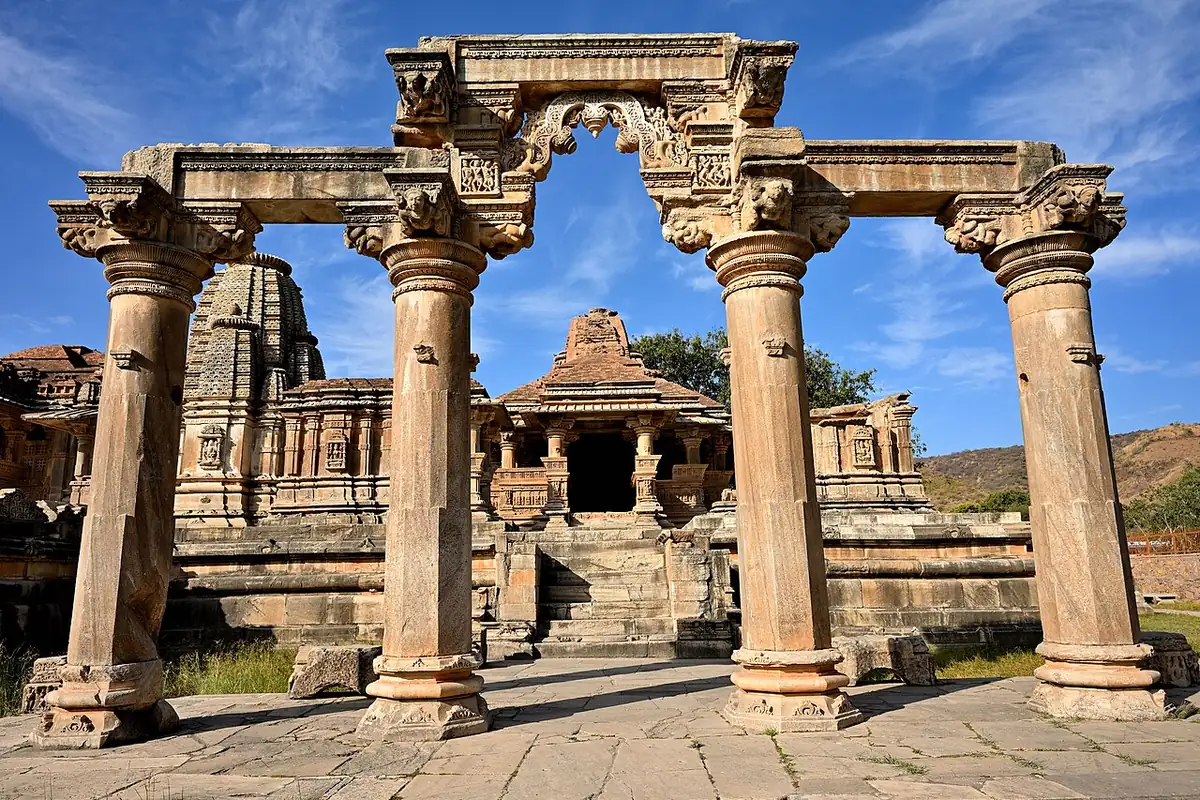

A pair of richly carved Vishnu temples at Nagda near Udaipur, built in about the 10th century. Their popular name Sas-Bahu, 'mother-in-law and daughter-in-law', comes from Sahastrabahu, the thousand-armed Vishnu.
HistoryDocumented history
Nagda was an early seat of the Guhila rulers of Mewar. The larger temple has a finely carved ceiling and an ornate entrance arch (torana), and the walls are covered with gods, dancers and scenes from the epics.
Sthala PuranaTradition
No ancient purana is recorded.
Aitihyas and storiesTradition and folklore
No local story is recorded.
PhilosophyInterpretation
The empty sanctums still carry the beauty their makers offered to Vishnu.
Meaning todayInterpretation
The temples are an important stop on heritage tours from Udaipur and Eklingji.
उदयपुर के पास नागदा में बारीक नक्काशी वाले विष्णु के दो मंदिर, जो लगभग 10वीं सदी में बने। इनका लोकप्रिय नाम सास-बहू, सहस्रबाहु अर्थात हज़ार भुजाओं वाले विष्णु से आया है।
इतिहासDocumented history
नागदा मेवाड़ के गुहिल शासकों की प्रारंभिक राजधानी था। बड़े मंदिर की छत पर सुंदर नक्काशी और प्रवेश पर अलंकृत तोरण है, और दीवारें देवताओं, नर्तकियों और महाकाव्यों के दृश्यों से भरी हैं।
स्थल पुराणTradition
कोई प्राचीन पुराण दर्ज नहीं है।
ऐतिह्य और कथाएँTradition and folklore
कोई स्थानीय कथा दर्ज नहीं है।
दर्शनInterpretation
खाली गर्भगृह भी वह सौंदर्य संजोए हैं जो शिल्पियों ने विष्णु को अर्पित किया।
आज का अर्थInterpretation
मंदिर उदयपुर और एकलिंगजी से होने वाली धरोहर यात्राओं का प्रमुख पड़ाव हैं।
यह अनुवाद एक प्रारंभिक मसौदा है और मूल भाषी द्वारा समीक्षा की प्रतीक्षा में है।
Timeline
- About the 10th c., by styleconstructedprobableThe twin temples are built at Nagda.
- Later medieval period; exact date unknowndamagedprobableThe temples are damaged and their images lost.
Videos
No videos have been curated for this temple yet.
Sources
- Photo: Sharvarism, CC BY-SA 4.0, via Wikimedia Commons
This entry is a draft. Traditional stories are presented as tradition, not as historical fact.
Suggest an edit
Spotted a mistake or know more about this temple? Tell us, with a source if you have one.